Beit Alfa Synagogue Mosaic
520
Hebrew year: 4280 (ד׳ר״פ)
Open on the interactive timeline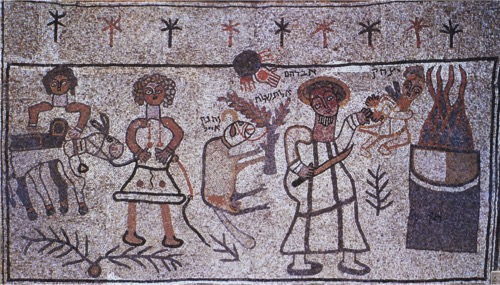
In the winter of 1928 members of Kibbutz Hefzibah, digging an irrigation channel at the foot of Mount Gilboa, struck a mosaic floor; Eleazar Sukenik of the Hebrew University excavated it the next year. An Aramaic inscription says the floor was laid in the reign of the emperor Justin, probably Justin I (518–527), paid for by the people of the village, and a Greek one adds: "Remembered be the craftsmen who made this work, Marianos and his son Hanina." The panel by the ark shows the Torah shrine between two menorahs, lions and birds; the middle panel a zodiac with Helios and the four seasons.
The panel at the entrance tells the Binding of Isaac (Genesis 22): the two servants with the donkey, the ram caught by its horn in a bush, Abraham holding Isaac and the knife, and a hand from heaven with the words "Do not lay [your hand]". It is among the best-known images of ancient Jewish art. The floor, still in place, is the heart of Beit Alfa Synagogue National Park.
- Hebrew year
- 4280 (ד׳ר״פ)
- Place
- Beit Alfa
- Category
- Archaeology
- Part of
- Byzantine Period
Read the text
- Genesis 22:12 · Hebrew and English on Sefaria