Hamat Tiberias Mosaic
300
Hebrew year: 4060 (ד׳ס׳)
Open on the interactive timeline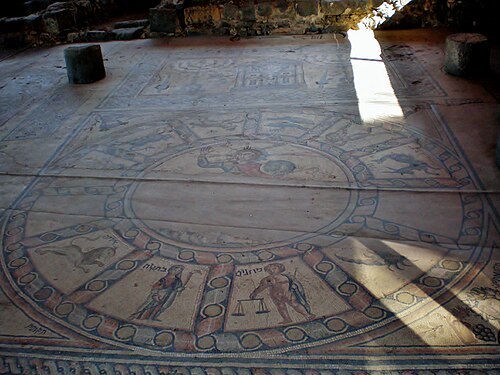
Hamat, the town of the hot springs just south of Tiberias, had a synagogue whose 4th-century floor is the oldest known zodiac mosaic in a synagogue in the Land of Israel. It was excavated by Moshe Dothan in 1961–1963. The floor has three panels. Nearest the ark, a Torah shrine stands between two seven-branched menorahs, with a shofar, a lulav, an etrog and an incense shovel. In the centre is a wheel of the twelve signs of the zodiac, each named in Hebrew, around the sun god Helios in his chariot, with the four seasons in the corners named after the months Nisan, Tammuz, Tishrei and Tevet. The panel at the entrance holds Greek inscriptions honouring the donors, among them Severus, "foster son of the most illustrious patriarchs".
The mosaic shows the Jews of Galilee in the age of the Mishnah and Talmud freely using the art of the Greco-Roman world to adorn the house of prayer, the zodiac marking the cycle of the Jewish year. Similar floors were later laid at Tzippori, Na'aran and Beit Alfa. The synagogue is part of Hamat Tiberias National Park.
- Hebrew year
- 4060 (ד׳ס׳)
- Place
- Tiberias
- Category
- Archaeology
- Part of
- Roman Rule