Sarajevo Haggadah
1350
Hebrew year: 5110 (ה׳ק״י)
Open on the interactive timeline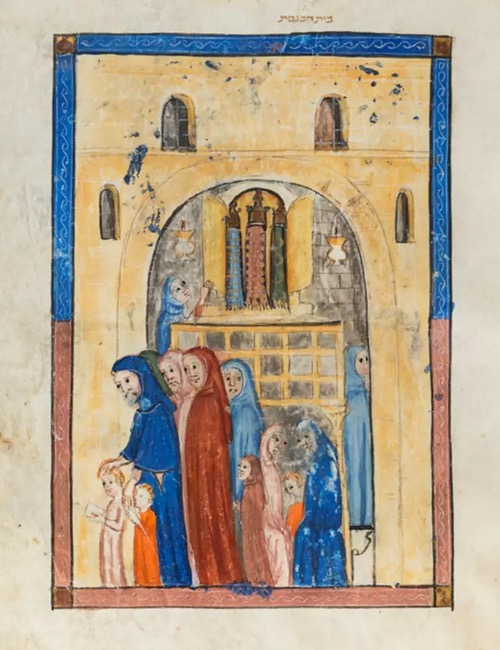
The Sarajevo Haggadah was made in Catalonia, probably in Barcelona, around 1350, on bleached calfskin decorated with copper and gold. Before the text of the Haggadah come 34 pages of paintings, from the Creation and the story of the patriarchs to the Exodus and the death of Moses, followed by scenes of Passover and a family at the seder. It is among the finest Sephardic illuminated Haggadot. Carried out of Spain in 1492, it was in Italy by 1609, when the censor Giovanni Domenico Vistorini wrote in it that it contained nothing against the Church, which saved it from burning. Wine stains show it was used at the table.
In 1894 it was sold to the National Museum of Bosnia and Herzegovina in Sarajevo, where it is still kept. During the Second World War the museum's chief librarian, Derviš Korkut, a Muslim scholar, hid it from the Germans; he and his wife, who also hid a Jewish girl, are honoured by Yad Vashem as Righteous Among the Nations. During the siege of Sarajevo in the 1990s it was kept in a bank vault, and it was restored in 2002.
- Hebrew year
- 5110 (ה׳ק״י)
- Place
- Barcelona
- Category
- Books, scripts & languages
- Part of
- Mamluk Period