Yiddish Emerges
Mar 1000
Hebrew year: 4760 (ד׳תש״ס)
Open on the interactive timeline
Yiddish began around 1000 among Jews who settled in the Rhineland and along the Danube. Its base is medieval German, mixed with Hebrew and Aramaic (loshn koydesh), with traces of Old French and Italian and, after Jews moved east, many Slavic words. It was always written in Hebrew letters. The oldest dated Yiddish sentence is a blessing written into the Worms Mahzor of 1272, and the Cambridge Codex of 1382, found in the Cairo Geniza, contains early Yiddish poems.
Printing spread Yiddish books to a wide readership. Elia Levita's adventure romance, the Bovo-Bukh, was printed in 1541, and the Tsene-rene, a retelling of the Torah written mainly for women, appeared around 1600. By 1939 some 11 to 13 million Jews spoke Yiddish, and it carried a whole modern culture of newspapers, theater, film and the literature of Sholem Aleichem and Isaac Bashevis Singer, who won the Nobel Prize in 1978. The Holocaust destroyed most of its speakers, yet Yiddish lives on, above all in Hasidic communities.
- Hebrew year
- 4760 (ד׳תש״ס)
- Category
- Books, scripts & languages
- Part of
- Early Islamic Period
At the same time
 Sherira Gaon906 – 1006
- Samuel ben Hofni Gaon920 – 1013
- Hai Gaon939 – 1038
- Rabbeinu Gershom960 – 1028
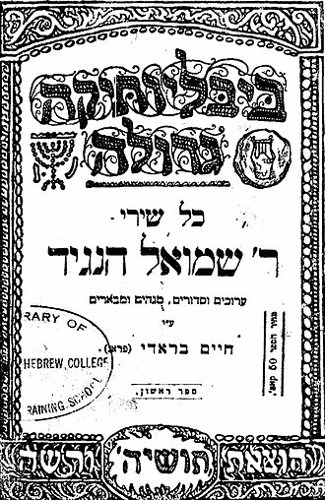 Shmuel HaNagid993 – 1056