Napoleon's Sanhedrin
1807
Hebrew year: 5567 (ה׳תקס״ז)
Open on the interactive timeline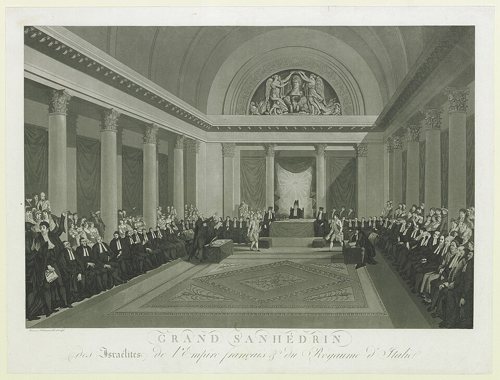
In July 1806 Napoleon called an Assembly of Jewish Notables, 111 deputies under the presidency of Abraham Furtado of Bordeaux, and put twelve questions to them. Did Jewish law allow polygamy? Did it allow divorce without a civil decree, or intermarriage? Did Jews regard Frenchmen as brothers and France as their fatherland? To give the answers religious authority, he then convened a "Grand Sanhedrin" of 71 members, 46 rabbis and 25 laymen, echoing the ancient court. It was presided over by Rabbi David Sinzheim of Strasbourg and met in Paris in February–March 1807.
The Sanhedrin declared that Jews were bound by the laws of the state, regarded France as their fatherland, and would serve in its army. It accepted civil marriage and divorce while keeping religious law for religious matters. In 1808 Napoleon organized French Jewry into state-supervised consistories. In the same year his "Infamous Decree" restricted Jewish moneylending and residence in eastern France for ten years. The model of Judaism as a religious confession within a nation-state shaped Western European Jewry.
- Hebrew year
- 5567 (ה׳תקס״ז)
- Place
- Paris
- Category
- Major events
- Part of
- Ottoman Period