Prophet Ezekiel (Exile)
−593 – −570
Hebrew years: 3332–3352 (ג׳של״ב–ג׳שנ״ב)
Open on the interactive timeline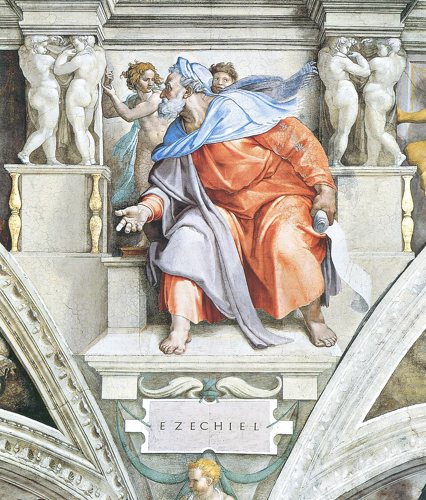
Ezekiel son of Buzi, a priest, was deported to Babylonia with King Jehoiachin in −597 and lived among the exiles at Tel-abib by the Kebar canal, near Nippur. In −593, the fifth year of the exile, he saw the vision that opens his book: a storm from the north, four living creatures with four faces, wheels "full of eyes," and above them the likeness of God's glory on a throne. He acted out his prophecies: he lay on his side for 390 days and then 40 beside a clay model of besieged Jerusalem, shaved his head and divided the hair, and was forbidden to mourn when his wife, "the delight of your eyes," died. He saw God's glory leave the Temple before its destruction, and taught that "the soul that sins, it shall die," rejecting the proverb that children's teeth are set on edge by their fathers' sour grapes.
After −586 he turned to restoration: the valley of dry bones rising to life (chapter 37) and a detailed plan of a future Temple and land (chapters 40–48). His opening vision, read on Shavuot, became the root of Jewish merkavah mysticism, and the Talmud (Shabbat 13b) relates that Hananiah ben Hezekiah burned 300 jars of lamp oil working to reconcile the book with the Torah. A traditional tomb of Ezekiel stands at al-Kifl in Iraq.
- Hebrew years
- 3332–3352 (ג׳של״ב–ג׳שנ״ב)
- Place
- Babylonia (the Kebar canal)
- Category
- Prophets of Israel
- Part of
- Babylonian Exile
Read the text
- Ezekiel 1 · Hebrew and English on Sefaria
At the same time
 Baruch ben Neriah−605 – −570
 Book of Daniel (Exile)−605 – −503
 Prophet Obadiah (Judah)−590 – −570
 King Zedekiah (Judah)−597 – −586
 Prophet Jeremiah (Judah)−627 – −586
- Governor Gedaliah−586 – −582